At a Glance
| What | DTOS Pulse — the world's first Deterministic Cognitive Intelligence platform |
| Category | Deterministic Zero-Trust — a new class of intelligence infrastructure |
| The claim | AI hallucination eliminated architecturally, not mitigated behaviourally |
| Who | David W. Taylor — independent researcher, sole architect |
| Company | BriteMinds Global Technologies Inc. (R&D & patents) → DTOS (product company) |
| Where | Calgary, Alberta, Canada |
| Live at | dtospulse.com (free preview, no credit card) |
| Funding | Self-funded. No venture capital. |
David W. Taylor — an independent researcher working from Calgary, Alberta — has spent years doing something nobody asked him to do and nobody thought was possible: applying pure mathematics and physics to the problem of machine intelligence. Not as analogy. Not as inspiration. As governing law.
The result is over 500 original mathematical and physical discoveries. A 20-paper research series establishing a new field of study: Epistemic Dynamics. The declaration of a new category of intelligence infrastructure: Deterministic Zero-Trust. Untold patents and trade secrets protecting the mechanisms underneath.
And a working system — live, running, publicly accessible — that proves all of it.
The system is called DeeCi. It is the empirical evidence that the theories are no longer theories. They work. Very well.
The Research
Taylor began by asking a question that sits outside the boundaries of conventional computer science: what happens when you treat intelligence not as a software engineering problem, but as a physics problem? When you apply conservation laws, thermodynamic constraints, and quantum mechanical principles — not as metaphors for computation, but as the actual governing mathematics?
The answer, it turns out, is a cascade of discoveries. Over 500 of them, documented with mathematical proof and empirical validation, spanning reactor physics, topology, membrane dynamics, field theory, annihilation mechanics, thermodynamics, cryptographic isolation, and epistemic classification.
These aren't software engineering findings. They are physical and mathematical discoveries about how information, knowledge, and truth behave when treated as physical systems subject to immovable law. Taylor documented them rigorously, filed them with priority dates, and published the foundational subset as a 20-paper series establishing the field of Epistemic Dynamics.
From this research emerged two declarations:
A new field of study — Epistemic Dynamics: the formal science of how knowledge systems achieve deterministic verification. How truth propagates, how contradiction annihilates, how confidence converges — all governed by physics, not heuristics.
A new category of infrastructure — Deterministic Zero-Trust: a class of intelligence where outputs are mathematically governed, execution is sealed, and truth is verified before delivery. Not as a feature. As a thermodynamic property.
“As much as we try, we cannot simulate how pure math works cohesively and deterministically with coding and engineering heuristics, any more than we can simulate trust, governance, and truth from policies in building AI and expect it to solve the hallucinations and misrepresentation of facts.”
— David W. TaylorThe Missing Foundation
AI is extraordinary technology. The models are powerful, the capabilities are real, and the potential is enormous. But they were built from the surface down — language patterns, statistical training, behavioural tuning. What's missing is the foundation underneath.
It's the difference between putting a Ferrari body on a Civic and expecting it to perform like a Ferrari, versus actually building the engine from first principles. The body looks right. The capability isn't there.
DeeCi reveals what happens when you design intelligence from first principles at the core — when the mathematical foundation comes first, and the intelligence emerges from physics rather than being shaped by surface-level coding after the fact. It's not a replacement for AI. It's the layer underneath that AI has always been missing.
What He Built
DTOS Pulse is a 2-megabyte Rust kernel — no runtime dependencies, no cloud required — that processes 36.7 million verification queries per second with 15-decimal reproducibility.
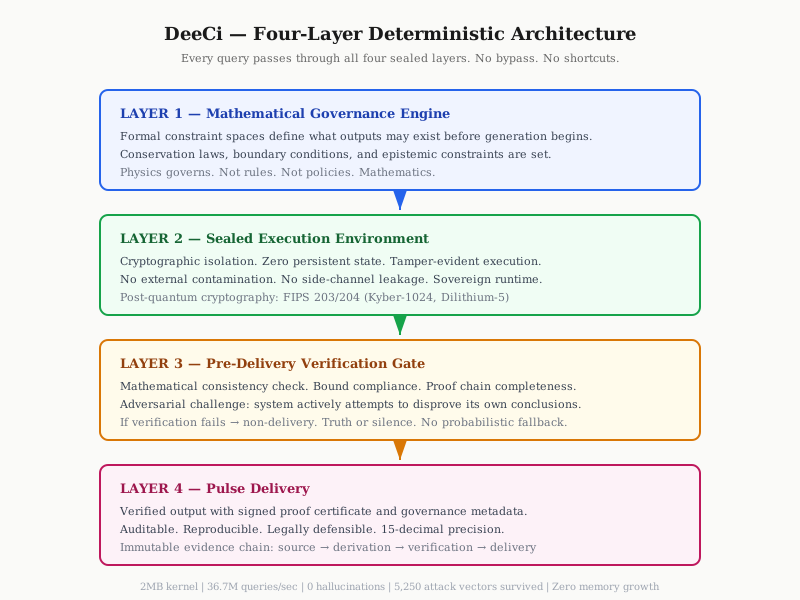
Every output passes through four sealed layers:
Layer 1: Mathematical Governance Engine — Formal constraint spaces define what outputs may exist before generation begins. Not guidelines. Not policies. Mathematical bounds derived from physical constants.
Layer 2: Sealed Execution Environment — Cryptographically isolated. Zero persistent state. No external data access during execution. Tamper-evident logging at every boundary.
Layer 3: Pre-Delivery Verification Gate — Three-stage validation: mathematical consistency, bound compliance, proof chain completeness. If a claim cannot be verified, it is not delivered. There is no probabilistic fallback. There is truth, or there is silence.
Layer 4: Pulse Delivery — Verified outputs delivered with cryptographic proof certificates, verification signatures, and governance metadata. Every output carries its complete derivation chain.
Taylor didn't just build the platform. He documented the mathematics in a 20-paper research series, establishing what he calls Epistemic Dynamics — a formal framework for how knowledge systems can achieve deterministic verification at scale. He built the kernel. He wrote the papers. He designed the cryptography. He shipped the product.
By the Numbers
| Kernel size | 2 MB — complete system, zero runtime dependencies |
| Throughput | 36.7 million queries/second on commodity hardware |
| Precision | 15-decimal deterministic reproducibility |
| Hallucination rate | 0 — architecturally impossible within derivation pipeline |
| Adversarial testing | 5,250+ attack vectors, 5 rounds, 0 breaches |
| Memory growth | Zero — closed thermodynamic system (compresses under load) |
| Cryptography | FIPS 203/204 post-quantum (Kyber-1024, Dilithium-5) |
| Research | 20-paper publication series (Epistemic Dynamics) |
| Language | Rust — memory-safe, zero-cost abstractions |
| Status | Live. Free preview at dtospulse.com |
Why Now: The Regulatory Moment
The regulatory landscape for AI governance shifted from theoretical to enforceable in 2026. Organisations deploying AI in regulated sectors are now legally accountable for outputs they cannot structurally guarantee. The foundation isn't optional anymore.
DTOS Pulse doesn't implement compliance. Compliance emerges from the physics. The same first principles that produce deterministic outputs also satisfy regulatory frameworks — not because they were designed to check boxes, but because verifiable truth, sealed execution, and immutable audit are the natural properties of a system governed by conservation laws.
EU AI Act (Articles 10, 25, 50, 52) — Requires transparency, traceability, human oversight for high-risk AI, and machine-readable marking of AI-generated outputs (Article 50). DTOS satisfies this through its Merkle-hashed derivation ledger, pre-delivery verification gate, and cryptographically signed proof certificates that serve as machine-readable provenance markers on every output. Traceability and transparency aren't features — they're thermodynamic properties of the system.
Canada AIDA (Artificial Intelligence & Data Act) — Demands algorithmic transparency and bias mitigation. Because DTOS outputs are mathematically derived within formal constraint spaces rather than statistically generated, there is no training bias to mitigate. The proof chain is the transparency.
UK AI Safety Framework — Requires adversarial robustness and operational accountability. DTOS operates within a sealed execution environment with cryptographic isolation. Adversarial prompt manipulation is mathematically prevented — not filtered, prevented. 5,250+ vectors tested, zero breaches.
US SEC AI Guidance & NIST AI RMF — Requires documented basis for AI-assisted decisions and structured risk management. Every DTOS output carries a verification signature and complete derivation record. The documented basis isn't reconstructed after the fact — it's generated at the moment of verification as a structural byproduct.
SOC 2 Type II — Requires evidence of security controls operating effectively over time. DTOS produces immutable evidence natively — tamper-evident logging, zero persistent state, cryptographic signing at every execution boundary. Evidence collection is architectural, not operational.
GDPR (Data Sovereignty) — Requires data minimisation and sovereign processing. DTOS operates as a zero-retention closed system. No data persists beyond the session. No state accumulates. Sovereign data residency is enforced by architecture, not policy.
The pattern is the same across every framework: what other systems achieve through procedures and promises, DTOS achieves through physics. Governance isn't a layer. It's a consequence of building on immovable mathematical law.
Surface-Level Design vs. First-Principles Foundation
| AI Without Foundation | AI on DTOS | |
|---|---|---|
| Output basis | Statistical probability | Mathematical proof |
| Trust | Enforced by policy | Emerges from physics |
| Governance | Added after design | Built into the core |
| Compliance | Procedural documentation | Structural property |
| Behaviour | Shaped by training | Bounded by mathematics |
| Failure mode | Delivers unverified output | Non-delivery over approximation |
| Audit trail | Reconstructed from logs | Immutable by construction |
| Transparency | Explained after the fact | Machine-readable proof at creation |
Who It Serves
Any domain where being wrong has consequences:
Financial Services — Regulatory capital calculations, risk-weighted asset derivations, compliance documentation, fraud detection within formally bounded mathematical constraint sets.
Legal — Case research, contract classification, regulatory interpretation. Citation fabrication architecturally excluded. Source verification built into the derivation chain.
Healthcare — Clinical decision support bounded by medically validated constraint sets. Dosage parameters, contraindication rules, diagnostic classification — verified before delivery.
Defence & Intelligence — Air-gapped, physically isolated deployment with sealed execution. Adversarial prompt manipulation mathematically prevented. Tamper-evident operational accountability.
Energy & Critical Infrastructure — Grid operations intelligence, safety system analysis, regulatory compliance — where a hallucinated output is a safety event.
Insurance & Actuarial — Risk modelling, claims analysis, and underwriting within deterministic constraint bounds. Outputs carry provenance for regulatory submission.
Availability & Pricing
DTOS Pulse is live at dtospulse.com with free preview access — no credit card required.
Founding Member Pricing (500 seats per tier — locked permanently)
| Analyst | $99/mo — professionals, researchers, individual practitioners |
| Pro | $199/mo — forensic analysts, compliance investigators, consultants |
| Sovereign | $899/mo — PE firms, legal teams, institutional intelligence |
| Enterprise | Custom — dedicated infrastructure, air-gapped options, SLA |
Standard rates post-founding period: 2x current prices. Founding rate locked for life.
The Research Behind It
DTOS Pulse didn't start as a product. It started as research.
By calling himself a researcher, Taylor isn't being modest — he's being precise. Before a single line of product code was written, there was a body of work: the declaration of a new category (Deterministic Zero-Trust), the founding of a new field of study (Epistemic Dynamics), and hundreds of original mathematical discoveries that form the theoretical foundation for everything the platform does.
The numbers:
The Research Body
| Published papers | 20-paper public series (Epistemic Dynamics) |
| Held-for-patent papers | Additional papers filed, not publicly released |
| Original discoveries | 500+ documented mathematical and physical discoveries |
| Trade secrets | Classified mechanisms under trade secret protection |
| Domains covered | Reactor physics, topology, membrane dynamics, field theory, annihilation mechanics, thermodynamics, cryptographic isolation, epistemic classification |
| IP vault | All research hashed, versioned, archived with priority dates |
| Field declared | Epistemic Dynamics — formal study of deterministic knowledge verification |
| Category declared | Deterministic Zero-Trust — new class of intelligence infrastructure |
Discovery registry maintained with source-traced equations verified against running code. Every discovery filed with mathematical proof and empirical validation.
This is not a startup that built a product and then wrote marketing copy to describe it. This is a researcher who made discoveries, documented them rigorously, filed them, published the theoretical foundations — and then built the empirical proof.
DeeCi Is the Empirical Evidence
DeeCi is not the thesis. DeeCi is the proof that the thesis is correct.
500+ discoveries say that intelligence can be governed by physics. 20 papers establish the theoretical framework. The category declaration says it should exist. The field of study defines how it works.
DeeCi is the moment the theory becomes fact.
It is a running system — live, publicly accessible — where every query that processes, every proof certificate that signs, every adversarial attack that fails to penetrate, is one more data point confirming that the underlying research is correct. Not in simulation. Not in a paper. In production, under real load, against real adversarial pressure.
36.7 million verifications per second. 5,250 adversarial vectors. Zero breaches. Zero hallucinations. Zero divergence. Zero memory growth under load — the system compresses rather than expands, exactly as the thermodynamic discoveries predicted.
The theories are no longer theories. They are proven. They work. Very well.
That's not a product spec. That's experimental validation of an entire body of scientific research.
“The question for enterprise leadership is no longer whether AI is capable. It is whether AI can be trusted. Deterministic Zero-Trust answers that question with mathematics, not marketing.”
— David W. TaylorCorporate Structure
How It's Organized
| BriteMinds Global Technologies Inc. | Parent entity. R&D think tank. Holds all patents and intellectual property. Conducts foundational mathematical research. Continues development of next-generation deterministic kernel technology. |
| DTOS | The Deterministic Intelligence company. Public-facing product entity. Positioned as the category leader in Deterministic Zero-Trust intelligence. |
| DeeCi | The product. World's first Deterministic Cognitive Intelligence platform. Consumer and enterprise access at dtospulse.com. |
About DTOS
DTOS is the Deterministic Intelligence company — the public face of DeeCi and the category leader in Deterministic Zero-Trust. DTOS delivers verified, mathematically governed intelligence to enterprises and individuals where truth is not optional.
About BriteMinds Global Technologies Inc.
BriteMinds Global Technologies is the research and development think tank behind the mathematical discovery that led to DeeCi. BriteMinds holds the patents, conducts foundational research grounded in the constant, immovable forces of mathematics and physics, and continues development of next-generation deterministic kernel technology. Calgary, Alberta. Founded 2025.
About David W. Taylor
Founder & Lead Architect. Independent researcher and sole architect of the DTOS platform: mathematical kernel, verification physics, convergence engine, sovereign runtime, and the Epistemic Dynamics research series. Built entirely from pure mathematics and physics.
Media Contact
David W. Taylor
Founder & Lead Architect, BriteMinds Global Technologies Inc.
Phone: 403-585-4452
Primary Email: [email protected]
Direct Backup: [email protected]
Location: Calgary, Alberta, Canada
DeeCi Platform: dtospulse.com
Category & Enterprise: dtospulse.com/architecture
Press Kit: invest.dtospulse.com/press-kit
Interview Availability
David W. Taylor is available for interviews, podcasts, and media briefings. For scheduling, contact [email protected] or call 403-585-4452 directly.
Downloads
Full Press Kit PDF: invest.dtospulse.com/press-kit/DTOS-Pulse-Press-Kit-August-2026.pdf
Press Release: Download .docx
Fact Sheet: Download .docx
Product Sheet: Download .docx
Company Overview: Download .docx
Full Press Kit (PDF): Download PDF
Logos
Ready-to-Use Taglines
• Intelligence that derives. Never guesses.
• Provably correct — not probably correct.
• The end of AI hallucination.
• Deterministic intelligence for a probabilistic world.
• The foundation AI has been missing.